
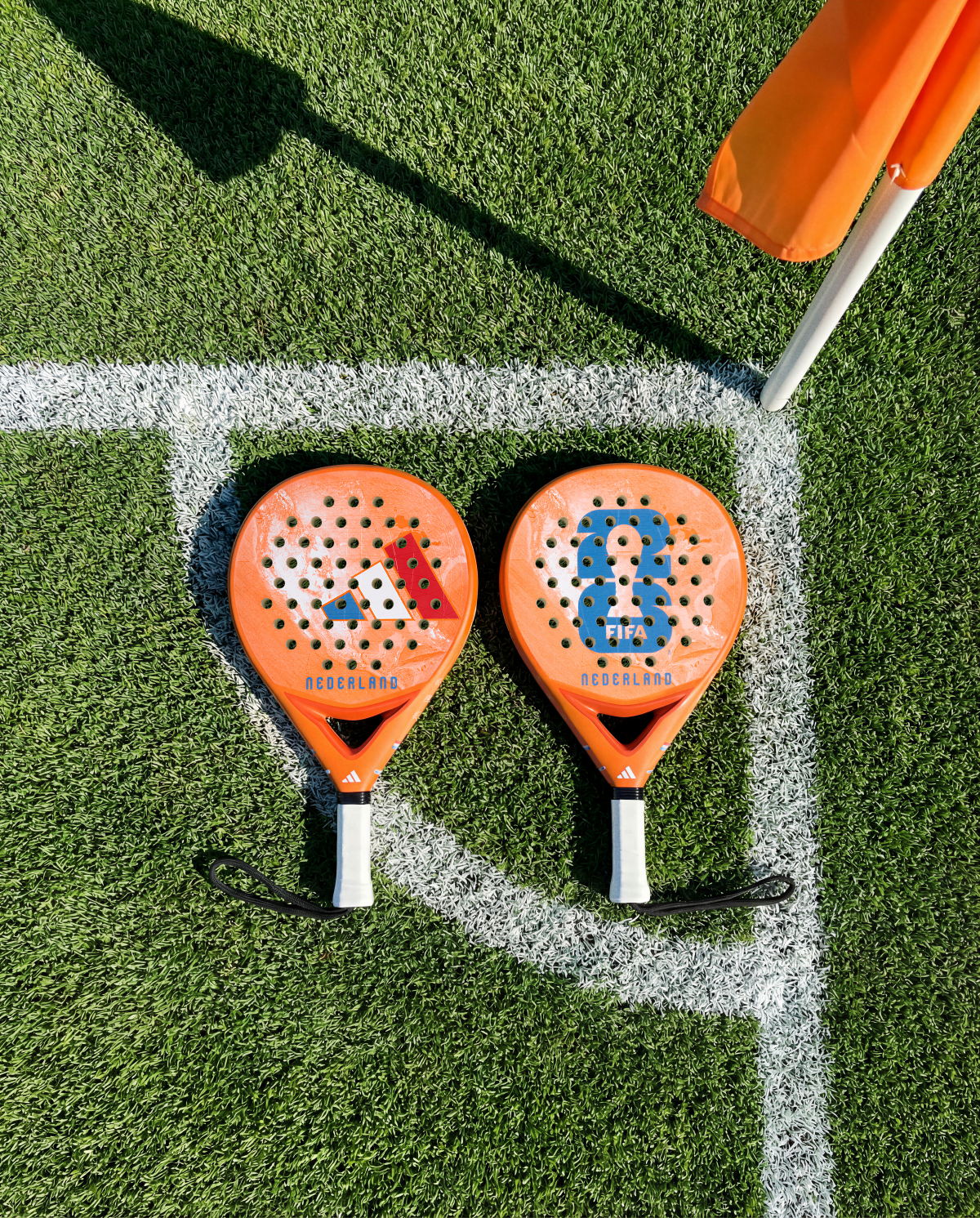
Padel is currently the fastest-growing sport, and it's not hard to see why: it's dynamic, social, and incredibly fun to play. But once you get a taste for it and want to buy your own padel racket, you'll quickly be overwhelmed with terms. Round, teardrop, diamond, carbon, fiberglass, EVA soft... Can you still see the forest for the trees?
Fortunately, at Padelbrouwerij, you've come to the right place. In our physical store, we always provide tailored advice and have test rackets ready for you to try out your new favorite first. Can't make it to our store? No problem! With this online guide, we'll be just as happy to help you get started.
There is no such thing as the perfect padel racket, but there is a perfect racket for you. Playing with the wrong racket not only leads to frustration on the court but can also cause nasty injuries, such as 'padel elbow'. In this blog, we'll guide you in a few simple steps to the racket that perfectly matches your level and playing style!
Step 1: Determine your level and playing style
Before we look at the racket's technology, we first look at you. Where do you stand on the court and how often do you play?
- The beginner: You've just started or play a few times a month with friends. You're still discovering your technique. Your priority? A racket that feels comfortable and is 'forgiving' when you don't hit the ball perfectly.
- The intermediate player: You've mastered the basics and play regularly. You're looking for a good balance between control (for precise shots at the back) and power (to smash the ball at the net).
- The advanced player: You play competitively or are on the court multiple times a week. Your technique is solid, and you're looking for a specific racket that maximally supports your playing style – offensive or defensive.
Step 2: The shape, weight, and balance (The Holy Trinity)
The shape of a padel racket largely determines how it responds. This has everything to do with the weight and balance (where the center of gravity is located). We distinguish three main shapes:
1. Round (Control & Comfort)
With a round racket, the weight is evenly distributed, placing the balance low (close to your hand). This makes the racket feel very light and agile. Moreover, the sweet spot (the ideal place to hit the ball) is precisely in the middle and is nice and large.
- For whom: Ideal for beginners, defensive players, and players prone to injuries.
2. Teardrop / Hybrid (The All-rounder)
The teardrop shape is by far the most popular shape on the padel court. The balance is centered (in the middle of the racket). It offers players the best of both worlds: sufficient control to build up play calmly, but also enough power when you want to accelerate.
- For whom: The perfect match for the all-round (intermediate) player who wants to be able to perform well anywhere on the court.
3. Diamond (Pure Power)
With a diamond-shaped racket, the balance is high (in the top of the racket). This creates a lever effect: when you swing, you automatically get an enormous amount of extra speed. The racket also feels heavier as a result. The sweet spot is higher and much smaller.
- For whom: Advanced and offensive players with good technique who are looking for maximum power in their smash.
Step 3: Carbon: Maximum power and durability
Carbon is extremely stiff, very hard, and very light. Because carbon does not flex, all the energy from your stroke is directly transferred to the ball. Do you hit hard? Then the ball will also go really, really fast. Carbon rackets also last much longer.
Are you rapidly improving your game? Switch to carbon! If you're now on the court weekly and notice your level rising quickly, then it's certainly wise to make the switch to a carbon racket. A fiberglass racket will eventually hinder your development. Carbon gives you the precision and power you need to grow.
Pay close attention to the number of 'K's'. When making the switch to carbon, you need to pay close attention to which type of carbon you choose. These rackets always have a number, such as 3K, 12K, or 18K. This stands for the number of thousands of carbon fibers per weave.
- Simply put: The higher the number, the more carbon has been used, and the stiffer and harder the racket feels.
- If you're just switching from fiberglass, 3K carbon is often the best choice: it's still relatively forgiving. A 12K or 18K carbon racket is a real, rock-hard 'weapon' for the advanced competitive player, but it also mercilessly punishes imprecise technique.
- Advantages: Enormous power, extreme precision, and a long lifespan.
- Disadvantages: More expensive to purchase and less forgiving (if you choose too high a K number and hit the ball incorrectly, you'll immediately feel the vibration in your arm).
- Ideal for: Advanced, ambitious, and competitive players.
Step 4: Don't forget the inside – The core (Soft vs. Hard)
As the final piece of the puzzle, we look at the inside: the foam core. The outer material works closely with the inner foam. Manufacturers cleverly coordinate this with the racket's shape:
- Control rackets (Round) + EVA Soft or FOAM: Round rackets are made for control. To enhance this, they are almost always equipped with soft foam (EVA Soft or FOAM). This maximally absorbs vibrations and gives you a lot of feel for precision shots and volleys at the net.
- Offensive rackets (Diamond) + Hard EVA: Diamond-shaped rackets are designed for pure power. To prevent the energy from your hard smash from being lost in soft foam, these rackets almost always have a core of Hard EVA. This compact foam hardly flexes, allowing you to literally smash the ball out of the court – provided you have the right technique!
Good to know: Padel rackets often don't differ much in absolute grams (usually between 350 and 375 grams), but due to the low balance, a round racket simply feels pounds lighter. Especially for women (and players who are prone to injuries), there are even lighter variants, which often weigh around 340 to 355 grams for optimal maneuverability.